“This will be the future”: the people Catalyse NEB 2026 is building for
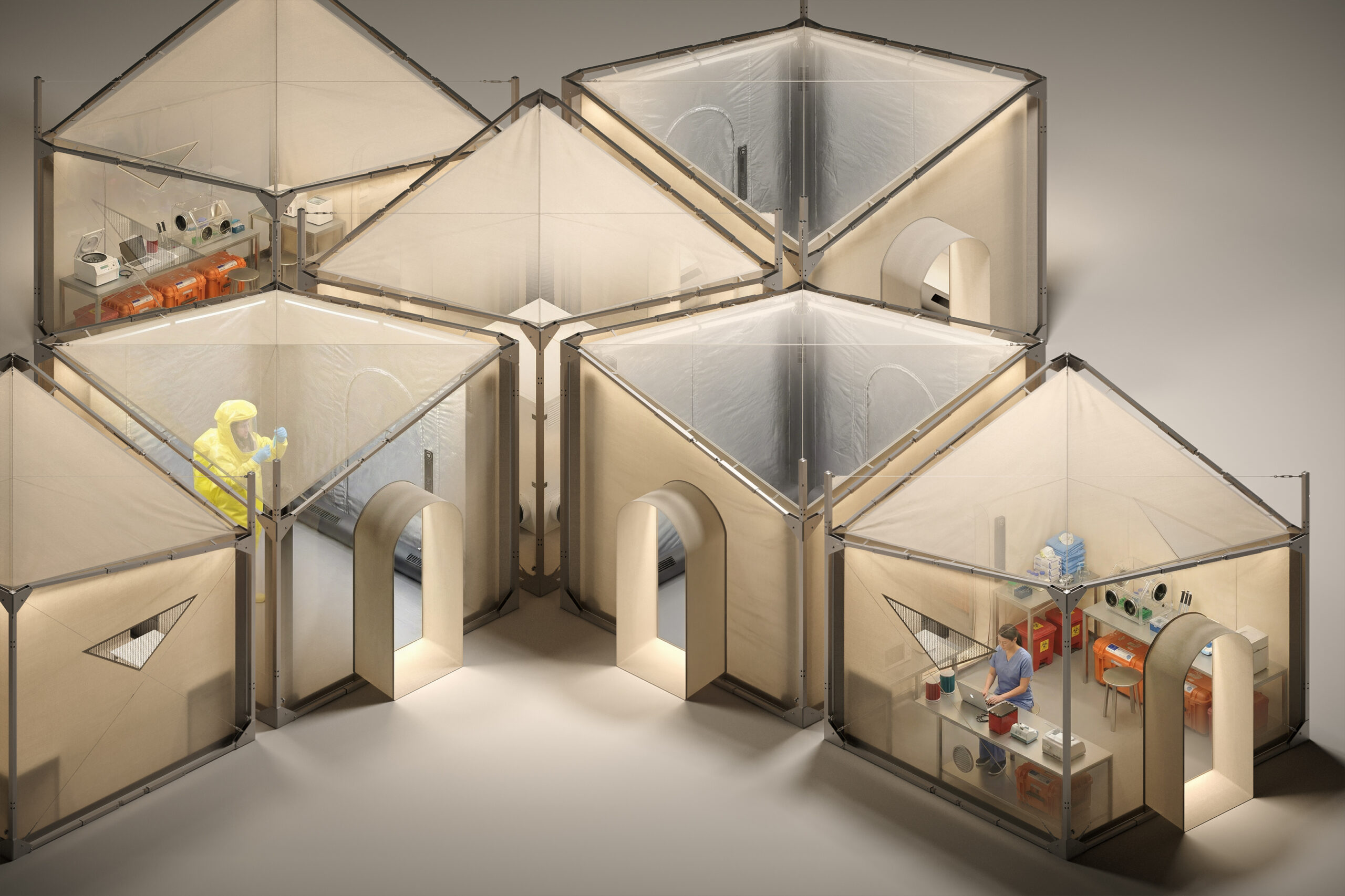
A team of health workers arrives at an Ebola response site in DR Congo and finds nowhere clean to work.
We use cookies on our website to enable the self-assessment tool, and to analyze website traffic by using Google analytics. By clicking ‘accept all’, you consent to our use of cookies and Google Analytics. You can find more information about the use of your data in our Privacy Policy.

On a windy Saturday in Madrid, the gates of El Retiro close, turning away families, runners and tourists. In London, an early biomethane process runs in a co-founder’s home, with his toddler’s highchair as the control centre. Somewhere else, a designer stands over a pile of wet, tangled mussel threads that no textile machine can handle, and decides to build the machinery herself.
In the first two parts of this series, we met founders of Catalyse NEB 2026 and the people they build for. In this final part, we look at the how: what these seven solutions actually do, and what makes them different from the usual fix.
One thing comes up again and again. Almost every team made a choice that made their work slower, harder or more expensive: no lithium, no added glue, no firing, no one-size-fits-all. And every one of them can tell you why they stuck with it.
The solution: a Daily Risk Index that reads the health of every single tree in a city
“Satellite data and AI are changing how cities are managed,” says Guillermo De Santiago De La Bárcena, CEO of Agforest. “For the first time, we can read the health of every single tree.”
That matters most on the days a city has to decide whether a park stays open:
“Picture a windy Saturday in Madrid. The forecast crosses a threshold and the gates of El Retiro close, turning away families, runners and tourists. For years, this is how cities have managed tree risk: one number, the maximum wind gust, deciding for every tree at once.
But wind is the trigger, not the cause. A healthy tree and a drought-stressed one don’t respond the same way to the same gust. That insight shaped our Daily Risk Index (IDR): stop asking ‘how windy will it be?’ and start asking ‘which trees are vulnerable today?’
The IDR reads each tree’s condition from satellite imagery and crosses it with years of georeferenced incidents and field inspections. Tested against three years of data in El Retiro, it anticipated 99.8% of recorded incidents, and showed the park could have stayed open 28 more days a year.”
For Agforest, the New European Bauhaus value of beautiful sits right there, in an open gate:
“A park with locked gates is beautiful to no one. The easy way to stay safe is to close more often or fell more trees. Proving it’s safe to stay open takes far more evidence. It’s the harder path, and the one we chose.”
The solution: a powered Drive Unit that moves 250 kg, with a trailer co-designed for each job
Most electric cargo equipment builds the motor into one vehicle, so a new job means a new machine. Slant pulled the two apart.
“Send a van on a short urban trip and you pay for congestion, parking and emission-zone charges to move a few hundred kilos across a postcode. Use a manual trolley and the limit is someone’s back and legs. The electric middle ground is cargo bikes and powered trailers. They usually cost £10,000 to £20,000 and build the motor into a single vehicle, so a council’s waste trolley and a courier’s parcel trailer each need their own.
We separated the two. Our Drive Unit is a patent-pending powered wheel module that makes moving 250 kg completely effortless, by bike or on foot. The equipment it moves is designed for the job. For Matt at Keert, a cycle logistics operator on the Isle of Wight, it’s a trailer we co-designed to move e-bikes and e-scooters. For Al at ETU Revival, a carpet cleaner in Bethnal Green, it’s a trailer we’re building with a fabricator near his business.
The hard lesson: we started out electrifying bike trailers for cycle couriers and assumed one trailer would suit everyone. Our trial with Pedal Collective showed an 88% productivity uplift, but every new operator asked for something different. So we stopped selling a trailer and started selling what moves it.”
That shift also shaped how Slant works with people, which is where the NEB principle of participatory design comes in:
“Customers who know the job, and know other operators who need the same thing, pay us to co-design their equipment. We simplify the design until any competent fabricator can build it, test it, and add it to our portfolio. When a new customer wants one, the nearest eligible fabricator builds it locally, and the original partner earns a royalty on every sale.
Designing for any fabricator made things slower. Producing a full manufacturing pack that a local fabricator can build from, with no back-and-forth, has taken far longer than we planned. Building it ourselves would have been quicker.
We stuck with it because it’s what lets the model scale: each trailer is built near its customer, and every design partner has a reason to bring us the next one. Matt knows his operation better than we ever will, and the royalty is how that knowledge gets paid for.”
The solution: passive cooling panels that store heat during the day and release it when temperatures drop
When a room gets too hot, the reflex is to turn up the air conditioning. Climasel starts somewhere else: with the building itself.
“We started asking a different question: what if the walls and ceilings could help manage some of that heat themselves?
We are developing passive cooling panels that use phase change materials (PCMs) to absorb excess heat during the day and release it when temperatures drop. Our approach combines bio-based fatty acids with a cellulose matrix and graphite to create a material designed for thermal regulation without electricity.
Getting the material right has been a process of trial and error. Our early prototypes showed us that choosing a promising material was only the beginning; we had to keep refining our formulations to balance thermal performance and practical application. We are now working towards testing the solution in real buildings, moving beyond laboratory experiments.”
For Climasel, sustainable is in the material, and in where it goes:
“It can be integrated into existing buildings without replacing their structure. We want passive cooling to become a practical part of how buildings are designed and renovated, not another system that requires additional energy to operate.”
The solution: load-bearing earth blocks and mortar made from excavation soil, without firing or added binders
Every year, the EU generates around 500 million tonnes of excavation soil. At the same time, construction keeps relying on virgin resources and energy-intensive manufacturing. earthbound sees one problem as the answer to the other.
“Rising energy and material prices since 2021 have further exposed the economic vulnerabilities of conventional building materials. At earthbound, we transform excavation soil into load-bearing earth blocks and mortar, without firing or additional binders.
Our technical breakthrough was developing a stable production process for highly variable raw materials while achieving high compressive strength. The result is a standardised, building-code-approved masonry product with over 90% lower production-related CO₂ emissions, and the potential for competitive costs at industrial scale.”
For earthbound, sustainable means building materials that let us build within planetary boundaries. The hardest part came from one deliberate choice:
“We deliberately chose locally available excavation soil over standardised virgin resources. This made development significantly harder, requiring extensive material qualification, precise process control and transdisciplinary collaboration between material scientists, engineers and architects to ensure consistent quality.”
The solution: acoustic and decorative panels made from mussel byssus, with parts that can be separated and replaced
Byssus is the tangle of fine threads mussels use to anchor themselves, and a waste product of mussel farming. Seastex‘s founder saw a material in it. Turning it into one took years.
“Mussel byssus is a challenging material to turn into a consistent manufacturing feedstock. It is wet, tangled and mixed with shell fragments, organic residues and contaminants: not something an interior designer can specify.
I discovered byssus waste in 2021 and spent the next two years learning how to clean, separate and process it. Conventional textile equipment wasn’t suited to its adhesive properties and irregular structure, so I developed scalable cleaning methods and machinery myself, drawing on my metalworking background and electromechanical engineering studies. In 2023, we presented 18 acoustic prototypes at London Design Festival, followed by Milan Design Week in 2024.”
At Seastex, sustainable and beautiful work together, right down to how a panel is put together:
“Our Acoustic Byssus Core panels combine a binder-free core with an aluminium frame and fabric upholstery, with components that can be separated and replaced. Our Natural Byssus Panels leave the fibres visible, making their texture and colour part of the interior. Avoiding added glue took more time and development, but it means we can recover and reprocess the byssus when a panel needs replacing.”
The solution: GLES, a modular system that stores energy as compressed air and water
A solar farm in Italy produces most of its energy at midday. The community it serves needs it at 7 PM. The usual answer is a bank of lithium-ion batteries. Blustorage asked whether a battery was needed at all.
“Lithium-ion relies on critical raw materials, degrades over time, and creates a future waste problem. We learned this the hard way while working with early partners: the more we calculated the true lifecycle cost of chemical batteries, from mining to disposal, the more we realised they weren’t the answer for long-duration, stationary storage.
So we took a different path. GLES is based on a liquid piston compressed air energy storage system. We use water to compress air, which stores energy. When you need electricity, the air expands, driving a turbine. The only ‘fuel’ is air and water.
We spent two years refining this with researchers from Sapienza University of Rome. The hardest part wasn’t the physics; it was making it modular and scalable, from 3.5 kWh for a single farm to 60 kWh for a small energy community. Sometimes the most advanced solution is the one that removes the most complexity.”
For Blustorage, sustainable is a design rule, and it came at a cost:
“We could have taken a shortcut by using off-the-shelf components that rely on rare earths, which would have accelerated our prototyping. Instead, we committed to a system that uses water and air. It slowed down our development, because we had to source and test materials that could withstand constant pressure and moisture without degrading.
But we stuck with it, because a sustainable energy storage solution cannot be built on an unsustainable supply chain. We established ourselves as a Benefit Company, so this commitment is embedded in our legal structure. The reward is a solution that farmers, marine operators and energy communities can trust to last for decades, without adding to the world’s battery waste.”
The solution: a unit that reads each load of waste and treats it with engineered biocatalysts before it reaches the digester
Biomethane plants turn food and farm waste into clean gas, but much of what goes in is too tough or too changeable to digest well. Potenix explains it best with a lorry:
“Picture a row of huge domes on a biomethane plant. Inside, bacteria digest food and farm waste and turn it into clean gas for the grid. Each dome is basically a giant stomach.
Masih and I were at the gate when a Greggs lorry pulled in, and the operator was delighted. Pastry is full of easy fat and carbs. Council food waste is trickier because it changes every load, and fibrous crop waste like straw is harder still. At one plant we work with, about a fifth of what goes in comes out undigested.
Plants cope by blending loads and buying in extra feedstock. Off-the-shelf biocatalysts run the same recipe on every load. Our unit sits before the digester. It senses what’s in each load, works out which of our engineered biocatalysts to use and how much, then acts by breaking the waste down so the stomach gets straight to the energy.
What surprised us, after 50+ conversations with operators, was how valuable the data is. Every load we treat links what came in, how we treated it and how the plant responded, and the industry has never had that. We already hold 1,000+ lab-validated feedstock records.”
And the NEB value? The team is refreshingly honest about that:
“We nearly picked beautiful as our NEB principle. Then we pictured the heavy machinery, conveyor belts of food waste and giant tanks of rotting mush. Still, that mush holds enough energy to help heat your gran’s house, which is pretty beautiful to us.
We went with transdisciplinary, because turning waste into more gas means bringing biotech, robotics and data together with real plant know-how. Masih has spent over a decade engineering biocatalysts, my background is customer experience and venture building, and operators have shaped the product from day one, including our first commercial pilot with a UK plant owner.
When we first built the full process, it lived in Masih’s home to keep it under wraps, with his toddler’s highchair as the control centre. It has since grown into a bigger unit at our R&D site in London. We built it lean, using industrial sensors and process equipment that already exist, and focused on the part nobody had built yet: turning a sensor reading into a decision about which biocatalysts go in and how much. It works because the biology, hardware and data were designed together.”
An open park gate on a windy day. A trailer built down the road by a local fabricator. A wall that cools a room without a plug. A brick made from the soil dug out for a basement. A panel you can take apart. Energy stored in air and water. A digester that finally gets the most out of yesterday’s waste.
None of these solutions took the shortest route. Each team chose a material, a partnership or a design rule that made things harder, because the easier version wouldn’t have been the solution they set out to build.
That brings our Catalyse NEB 2026 cohort series to a close. Across three parts, we’ve met the founders, the people they build for, and now the solutions themselves. Thank you to all twenty startups for sharing their stories so openly, including the parts that are still a work in progress.
Is it your turn? If you’re building something your community, your city or your landscape needs, the Catalyse NEB 2027 open call is now open.
A team of health workers arrives at an Ebola response site in DR Congo and finds nowhere clean to work.

A pomegranate pushed off a sorting line in Peru because of a scratch on its skin. A room in Gabon